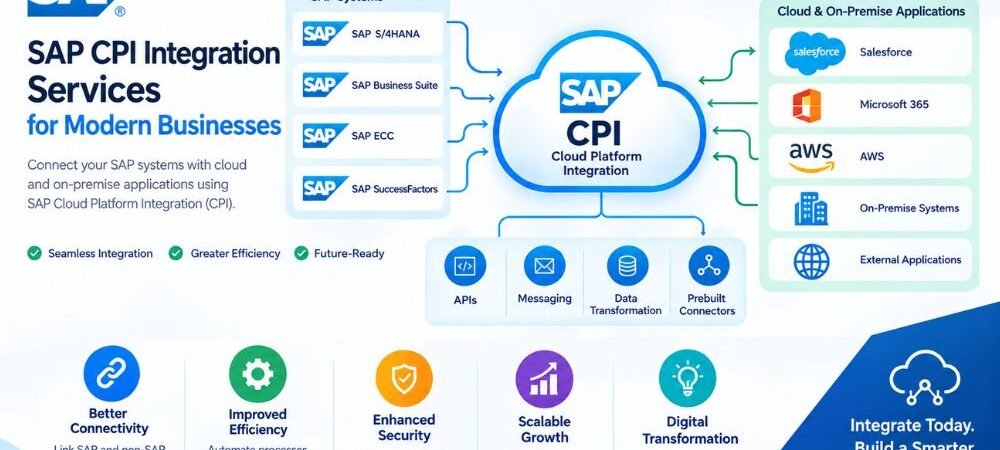
Modern businesses use multiple applications to manage finance, sales, customer data, supply chains, human resources, e-commerce, and other operations. When these systems cannot exchange data properly, teams may need to enter the same information more than once. This can create delays, duplicate records, and data errors.
SAP CPI Integration Services help businesses connect SAP and non-SAP applications through cloud-based integration. SAP Cloud Integration, commonly associated with SAP CPI, is part of SAP Integration Suite on SAP Business Technology Platform (SAP BTP). It supports application-to-application (A2A), business-to-business (B2B), and business-to-government (B2G) integration across cloud, on-premises, and hybrid environments.
For businesses using SAP S/4HANA, SAP ERP, Salesforce, ServiceNow, Workday, Microsoft applications, e-commerce platforms, databases, APIs, and other systems, SAP CPI Integration Services can provide a structured way to exchange and transform business data.
What Are SAP CPI Integration Services?
SAP CPI Integration Services refer to professional services for designing, developing, deploying, monitoring, and maintaining integrations using SAP Cloud Integration within SAP Integration Suite.
SAP Cloud Integration works as an integration layer between sender and receiver systems. An integration flow can receive information from one system, transform the message, apply routing or processing logic, and deliver the result to another system. SAP states that Cloud Integration can connect SAP and third-party applications and support cloud, on-premises, and hybrid landscapes.
For example, an e-commerce platform may send a new customer order to SAP S/4HANA. The integration can transform the order data into the format required by SAP, process the message, and send it to the target system.
This creates a connected flow such as:
E-commerce → SAP CPI → SAP S/4HANA → Warehouse → Customer Notification
The exact architecture depends on the applications, interfaces, business rules, security requirements, and data formats involved.
Why SAP CPI Integration Matters for Modern Businesses
Business applications often use different data structures, communication methods, and interface standards. One application may use REST APIs, while another may use SOAP, OData, IDoc, SFTP, or other integration methods.
SAP Cloud Integration provides integration capabilities for message processing, routing, mapping, transformation, and process orchestration.
SAP CPI Integration Services can help organizations create connections between systems without building separate point-to-point connections for every application.
A centralized integration layer can also make it easier to monitor integration flows and manage changes. SAP Integration Suite provides tools for designing, operating, and monitoring integration artifacts.
SAP CPI Integration Services for SAP and Non-SAP Systems
One of the key requirements in enterprise integration is connecting SAP applications with non-SAP applications.
SAP Integration Suite supports both SAP and third-party systems through APIs, adapters, prebuilt integrations, connectors, and event-based connectivity.
A typical integration environment may include:
SAP S/4HANA, SAP ERP, SAP SuccessFactors, SAP Ariba, Salesforce, ServiceNow, Workday, e-commerce platforms, external databases, APIs, and partner systems.
For example, customer information can move from a CRM platform to SAP. Product information can move between SAP and an online store. Employee data can be synchronized between an HR platform and SAP.
The integration design depends on the business process and the technical interfaces provided by each application.
Core Capabilities of SAP CPI Integration Services
Integration Flow Development
An integration flow defines how messages move between systems. It can include sender and receiver connections, routing, transformations, mappings, validation, processing steps, and error handling.
SAP Cloud Integration provides different integration patterns and flow steps for processing messages.
A professional implementation can therefore create integration flows based on specific business requirements instead of using the same configuration for every system.
Data Mapping and Transformation
Different applications often represent the same business information in different formats.
For example, one application may use:
CustomerID
while another may use:
CustomerNumber
A mapping process connects these fields so that the receiving application can correctly understand the data.
SAP Cloud Integration supports message mapping and transformation capabilities that allow data structures and formats to be changed between sender and receiver systems.
API Integration
APIs provide structured methods for applications to communicate. SAP Integration Suite includes API Management alongside Cloud Integration.
API Management can help organizations secure, publish, govern, monitor, and manage APIs.
This makes API-based integration useful when applications need controlled access to business data or services.
Application-to-Application Integration
A2A integration connects applications inside an organization.
For example:
SAP S/4HANA → CRM
or
SAP S/4HANA → Warehouse Management System
A2A integration can support automated data exchange between departments and business applications.
B2B Integration
Businesses often exchange information with suppliers, distributors, logistics companies, and other partners.
SAP Integration Suite supports B2B and EDI scenarios, including partner management, mapping, validation, and monitoring.
This can support business documents such as purchase orders, invoices, shipping information, and other partner messages.
Event-Driven Integration
Modern applications may need to respond when a business event occurs.
For example, a stock-level event can trigger an inventory process. An order event can trigger downstream processing. SAP Integration Suite supports event-driven architectures through capabilities such as Event Mesh.
Event-driven integration can reduce dependence on scheduled data transfers when near-real-time processing is required.
SAP CPI Integration Services for Hybrid Environments
Many organizations operate both cloud and on-premises systems.
SAP Integration Suite supports hybrid integration scenarios where applications can reside in cloud environments, private environments, or on-premises landscapes.
A hybrid architecture may connect:
On-Premise SAP ERP → SAP Cloud Integration → Cloud CRM
This approach allows organizations to connect existing enterprise systems with newer cloud applications without requiring every system to operate in the same environment.
SAP CPI Integration Services and Data Security
Enterprise integrations often handle sensitive business information. Security therefore needs to be considered at the integration, API, authentication, authorization, and transport levels.
SAP Integration Suite includes security and governance capabilities for APIs, integrations, events, and partner interactions.
A suitable implementation should consider authentication methods, authorization, secure communication, credentials, access controls, logging, monitoring, and organizational security policies.
Security requirements should be defined according to the systems and data being connected.
SAP CPI Integration Services for Data Synchronization
Data synchronization keeps information consistent between applications.
For example, a company may maintain customer information in a CRM system while financial and order information is maintained in SAP.
An integration flow can synchronize selected information between these systems according to defined business rules.
This can reduce manual data entry and help keep records aligned across connected applications.
SAP CPI Integration Services and Automation
Integration is closely connected with business process automation.
When systems can exchange information automatically, one business action can trigger another system process.
For example:
A customer places an order → the order enters the integration flow → data is transformed → SAP receives the order → warehouse processing starts → the customer receives an update.
The actual process depends on the organization’s systems and integration design.
How SAP CPI Integration Services Work
A typical SAP CPI integration process contains several stages.
First, the integration identifies the sender and receiver systems. Next, the required connection method is configured. The incoming message is then processed according to the integration flow.
The flow may perform data mapping, transformation, validation, enrichment, routing, or other processing. Finally, the processed message is delivered to the target system.
SAP describes Cloud Integration as a platform for designing and running integration flows that exchange data between connected sender and receiver systems.
The integration can then be monitored to identify processing status, errors, and other operational information.
SAP CPI Integration Services for Digital Transformation
Digital transformation often involves connecting existing enterprise applications with cloud services, APIs, data platforms, and modern business applications.
SAP Integration Suite is designed to support application integration, API management, event-driven integration, B2B integration, hybrid integration, and other enterprise integration scenarios.
This makes integration an important technical layer for organizations moving from disconnected applications toward connected business processes.
SAP also provides migration capabilities for organizations moving from legacy SAP Process Orchestration environments toward SAP Integration Suite.
SAP CPI Integration Services for Common Business Use Cases
SAP CPI can be used in many enterprise scenarios.
A retail company can connect its e-commerce platform with SAP for order and product processing.
A manufacturing company can connect SAP with warehouse, logistics, supplier, and production systems.
A service company can connect CRM applications with SAP financial and customer processes.
An organization using cloud HR software can integrate employee information with SAP systems.
A business working with external partners can use B2B integration to exchange structured business documents.
The required integration pattern depends on the business process, data volume, interface technology, security model, and target architecture.
Choosing SAP CPI Integration Services
A successful integration project starts with clear requirements.
The first step is to identify the systems that need to communicate. The next step is to define the data that needs to move between them.
The integration team should then determine the available interfaces, such as APIs, IDocs, OData, SOAP, REST, SFTP, or other supported connectivity options.
Data mapping requirements, transformation rules, error handling, security, monitoring, performance, and future maintenance should also be defined before implementation.
For organizations with multiple integrations, a standardized architecture can make future development and management easier.
AEO and GEO for SAP CPI Integration Services
AEO, or Answer Engine Optimization, focuses on making content clear enough for search engines and answer systems to understand and extract useful information.
For SAP CPI content, direct questions and concise answers can improve clarity for users searching for specific information.
Examples include:
What is SAP CPI?
SAP CPI commonly refers to SAP Cloud Integration, a cloud-based integration capability within SAP Integration Suite that connects SAP and non-SAP applications across cloud, on-premises, and hybrid environments.
What does SAP CPI integrate?
SAP Cloud Integration can connect SAP applications, third-party applications, cloud systems, on-premises systems, APIs, and business partners depending on the available interfaces and integration requirements.
GEO, or Generative Engine Optimization, focuses on creating structured, factual, and context-rich content that can be understood by AI-powered search and answer systems.
Using clear definitions, relevant SAP entities, technical terms, use cases, and direct answers helps establish strong topical context without relying on keyword repetition.
Benefits of Professional SAP CPI Integration Services
Professional integration services can cover the complete integration lifecycle, including planning, development, testing, deployment, monitoring, and maintenance.
A structured approach can help businesses manage complex connections between multiple systems. It can also support consistent data exchange, automated processes, centralized monitoring, and hybrid application connectivity.
SAP Integration Suite provides prebuilt integration content and connectors that can help accelerate integration projects. SAP currently describes the platform as providing thousands of prebuilt integrations and accelerators.
The actual project benefits depend on the systems, integration scope, data volume, architecture, and implementation quality.
Frequently Asked Questions
What is SAP CPI?
SAP CPI commonly refers to SAP Cloud Integration. It is an integration capability within SAP Integration Suite that enables businesses to connect SAP and non-SAP applications and exchange data across cloud, on-premises, and hybrid environments.
What are SAP CPI Integration Services?
SAP CPI Integration Services include planning, designing, developing, testing, deploying, monitoring, and maintaining integrations using SAP Cloud Integration. These services can connect applications, transform data, route messages, and automate business processes.
Can SAP CPI connect SAP and non-SAP applications?
Yes. SAP Cloud Integration supports integration between SAP and third-party applications. SAP Integration Suite provides prebuilt integrations, adapters, APIs, and connectors for different integration scenarios.
Does SAP CPI support cloud and on-premises systems?
Yes. SAP Cloud Integration supports hybrid integration scenarios involving cloud and on-premises applications.
What data formats can SAP CPI process?
The supported formats depend on the integration scenario and available adapters and processing capabilities. Integration flows can transform messages between different structures and formats using mapping and transformation capabilities.
Can SAP CPI integrate APIs?
Yes. SAP Integration Suite includes Cloud Integration and API Management. API Management provides capabilities for securing, publishing, governing, and monitoring APIs.
Is SAP CPI suitable for B2B integration?
Yes. SAP Integration Suite supports B2B and EDI integration scenarios, including partner management, mapping, validation, and monitoring.
What is the difference between SAP CPI and SAP Integration Suite?
SAP Cloud Integration is a specific integration capability within SAP Integration Suite. SAP Integration Suite is the broader platform that includes capabilities such as Cloud Integration, API Management, Event Mesh, Open Connectors, Integration Advisor, and Trading Partner Management.
Conclusion
SAP CPI Integration Services provide a structured approach to connecting SAP and non-SAP applications, APIs, business partners, and cloud or on-premises systems. SAP Cloud Integration supports integration flows, message processing, data mapping, routing, transformation, and process integration across different environments.
For modern businesses, integration can connect separate applications into coordinated business processes. SAP Integration Suite extends this capability with API management, event-driven integration, B2B connectivity, prebuilt integrations, and hybrid integration support.
Organizations planning SAP CPI Integration Services should define their systems, interfaces, data flows, security requirements, business processes, and monitoring needs before implementation. A clear integration architecture can provide a foundation for reliable system connectivity and future expansion.